

(Mild spoilers for the movie Sinners.)
Movies aren’t meant to be content. I think the Netflix era has made us forget that. They’re not like podcasts or lo-fi music, things we passively ingest while we do the laundry or finish our homework. That kind of media has its place, but movies are different. Movies are intentional, multi-sensory experiences that are worthy of our full attention.
That’s why I like watching movies in theaters. At home, I have a hard time sitting long enough to enjoy a movie in one sitting. Chalk it up to ADHD, the myriad chores around the apartment, or the infinite other stimuli the internet puts at my fingertips. But in a movie theater, I’m more than happy to stay riveted to my seat for two hours or longer. I love the ceremony of getting popcorn and soda, like I’m getting wine and bread for communion, less with the Holy Spirit and more with the human spirit.
I’ve been telling friends and strangers alike that you need to see Ryan Coogler’s Sinners in the movie theaters while you can, because it’s a reminder of why movie theaters exist in the first place. If you’ve seen the trailer, you know what it’s about: two fraternal gangsters known as the Smokestack Twins return from 1930’s Chicago to start a juke joint in their hometown of Clarksdale, Mississippi. In doing so, they radically alter the life of their cousin Sammie, a guitar-slinging blues prodigy, while enticing a terrifying trio of music-hungry vampires out of the Delta darkness.
When I say this movie should be seen in theaters, I’m thinking of the scene where Sammie first plays his first song. As his music swells, the camera circles the juke joint in one continuous, mesmerizing shot. As it does, spirits from the past and future of the blues appear, from modern hip-hop to African folk music, weaving fluidly into each other, and growing with such intensity that the juke joint erupts in metaphysical flames. Rarely do I drop my jaw in any literal sense, but that scene had me breathless. It’s one thing for a movie to say that music has otherworldly power. It’s another thing to make you feel that power in your bones. And I can’t imagine that feeling happening on a flat-screen TV in my living room, knowing there are dirty dishes in the sink.
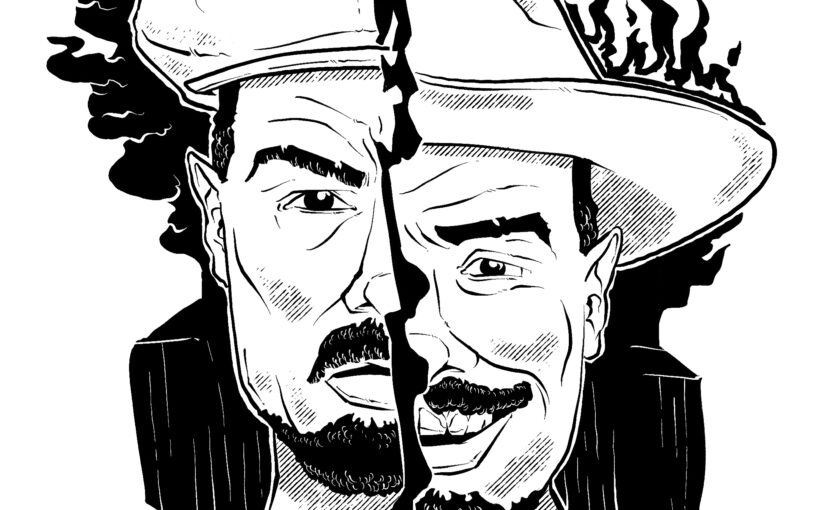
There are elements of this movie that steal the air from my lungs even in retrospect. For example, if you told me that Michael B. Jordan had a twin and was not, in fact, playing two people in this movie, I would have believed you. When the Smokestack Twins are introduced, they exchange a cigarette, and my thought was, “Wow, that was really seamless.” From that moment forward, I forgot they were one actor, as if they had just hypnotized me with a close-up magic trick.
Honestly, the acting was magic in general. I could’ve watched Delroy Lindo deliver hours’ worth of monologues. Wunmi Mosaku and Hailee Steinfeld were as perfect as tightrope walkers. And the fact that Miles Caton could anchor the film as Sammie with such tenderness and sincerity, while learning competent blues guitar, in his first acting role ever, is a testament to his own artistic prodigy.
The character I can’t stop thinking about is the vampire Remmick, and the relationship of vampirism to Whiteness in this movie. It would’ve fit the narrative alright if Coogler had made his vampires overt White racists, like the clan member that sells the juke joint to the twins. Instead, he made Remmick an Irish American, old enough to have endured centuries of oppression at the hands of the English. He’s sympathetic to the plight of Black Americans, but his remedy for their pain—the vampire transformation—is nothing more than a living death. It may offer them unity and power under the guise of “fellowship and love,” but it ultimately incarcerates the soul.
You can hear Remmick’s own soul crying out from its prison, as he dances a jig and sings a raucous, haunting rendition of “Rocky Road to Dublin,” trying to coax his victims to let him into the juke joint. The metaphor for Whiteness is as subtle as a stake through the heart. It’s a consumptive force that can only devour, imitate, and suppress, and it’s worth exposing to the sunlight, to let its power wither, so we can all reclaim what’s been taken from us.
See Sinners in theaters if you can. Be bathed in the blood.