
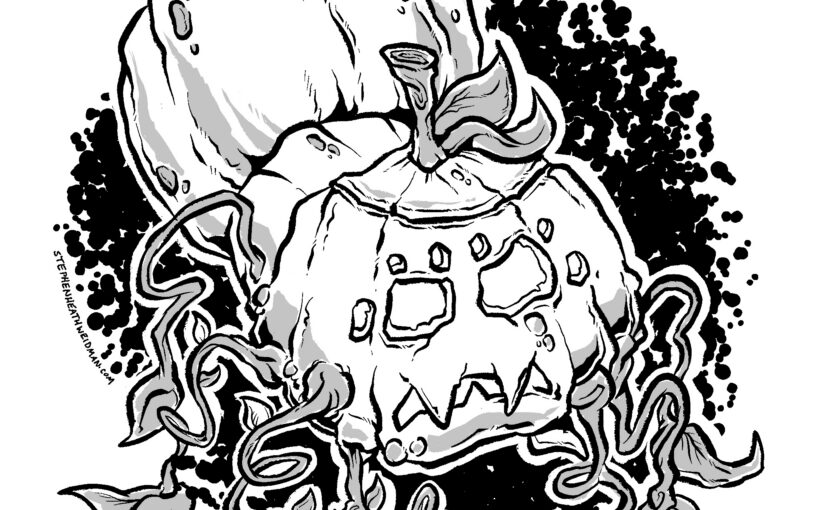

I’m getting back into the FancySchmancy Creature Feature on a regular basis! We’re getting spooky season started early. This week’s theme is arachnids. The suggestion for “Pumpkin Spider” comes courtesy of Twitch user jackofallcraftsstl.
I’m getting back into the FancySchmancy Creature Feature on a regular basis! We’re getting spooky season started early. This week’s theme is arachnids. The suggestion for “Pumpkin Spider” comes courtesy of Twitch user jackofallcraftsstl.

(Photo by Christian Wiediger | Unsplash)
Last week one of Anthropic’s departing AI researchers Jacob Coxon gave an interview to WIRED, saying that in his view, and in the view of his former colleagues, there’s a non-zero chance that AI wipes out every human on earth within the next decade.
In a sane world, claiming you created a doomsday device with a ten-year timer would get your ass hauled to a Congressional hearing, maybe even the Hague for shits and giggles. Instead, the big question (at least according to the spiritual husks in my LinkedIn newsfeed) about the book-shredding, earth-cooking, porn-churning death machine that Coxon helped spring to life was: how will this affect Anthropic’s IPO?
Cool.
To be clear, I think Coxon’s prophecies are utterly hollow. For one thing, you don’t have to wait a decade to experience the life-altering devastation of genAI. You could live in a disenfranchised neighborhood that is now forced to host the vibrating, brutalist monstrosity that is an AI data center, as it feasts on electricity and defecates in your ground water. You could lose a loved one to the abyssal entanglement of chat-induced psychosis. You could have your job cut, your work scraped, your voice mimicked, your nudes fabricated, your life hacked. And if that fails, you can enjoy being locked in the backseat of a slow-rolling climate disaster, now with a brick on the gas pedal because your grandma in south Florida wanted a few more pics of Jesus petting her shih tzu.
There’s no need to worry about genAI creating hell on earth in the future. As an AI-hallucinated Jesus might say (after he’s done ruffling Fifi’s little mop top): hell is already at hand.
Secondly, nothing Coxon said in that interview was more substantial than the weird, reckless, apocalypse cult-coded PR campaigns that his former bosses at OpenAI and Anthropic have been hawking since day one. And as somebody with almost two decades of PR and marketing work under his belt, may I ask: what the fuck? Why is any company allowed to advertise the world-ending, unpredictable deadliness of their product with this level of impunity? “This will destroy you, buy it anyway” has never been great advertising.
The reality is, they feel this impunity because we, the everyday computer user, are not their customer, if we ever were. A dangerous system is a powerful system, and to many corporations and governments, the words “dangerous” and “power” both equate to domination. Never mind whether or not an LLM is actually either of those things, so long as Wall Street buys the grift for a little bit longer. Sure, stoking fears of annihilation in the general populace is a shame, but what’s a little psychological collateral damage, compared to the payout of an inflated IPO, before the bubble finally bursts?
No hard feelings, right, humanity? You should have seen the look on your faces.
“Competency porn” is a genre of media where the audience gets to revel in the ecstasy of people doing their jobs well. Some of the best examples to me are Andy Wier stories like The Martian or Project: Hail Mary, where a good-humored egghead pushes the limits of his noggin to evade certain death in space. But if you want something a little closer to Earth, then Phil Edwards has your ticket.
Specifically, it’s a ticket to the National Truck Driving Championships in Pittsburgh, Pennsylvania, where the country’s best drivers maneuver commercial trucks around a variety of obstacles for a shot at gold—made all the more whimsical by their rubber duck mascot. In an AI-saturated world that pits man against machine and tries to de-skill the labor force, there is something very satisfying about watching a driver, like a sci-fi hero who’s honed a symbiotic relationship with his mech, park it with all the satisfaction of a DVD logo finally hitting the corner of your TV screen.
Check your mirrors, throw it in reverse, and give it a watch.

A psychologist wakes up tied to a chair in the warped simulacra of a mid-century dining room, surrounded by mute Escher-esque homunculi and the spiraling, knife-wielding furniture salesman she was trying to rescue. She asks his carnivorous, elongated doppelgänger, who is wearing a pirate costume, “why the long face?”
Guess you had to be there.
⭐️ 8.5/10

My first thought while I was leaving the theater after watching Christopher Nolan’s The Odyssey was, damn, Oppenheimer II was really good.
Silly as that sounds, I don’t think it’s a stretch to consider it a sequel, at least in theme. In fact, Nolan’s not even being subtle about it, especially in the final act of the movie. (Spoilers ahead for a 3,000-year-old Homerian epic.)
When Matt Damon’s Odysseus returns to Ithaca disguised as a beggar, he delivers a monologue to his wife Penelope about the sacrilege of the Trojan Horse. He muses about how it broke the bonds of civilization, turning the beauty of gift-giving into an omen of destruction. To me, there’s a straight line from that monologue to the ruminations of Cillian Murphy’s Oppenheimer, after he used the elegant act of science to split the atom and shatter the world.
Nolan loves heroes who are haunted by their own ingenuity. Men create extraordinary things—a teleportation machine, a crime-fighting persona, a hydrogen bomb, a miraculous statue—and like Frankenstein’s monster, those things become the specters that won’t stop haunting their conjurers. Maybe it’s a metaphor for the burden of craft, that what we pursue as an expression of our genius inevitably devours our world. Maybe it’s Nolan the brilliant, ambitious filmmaker saying he needs to take a vacation.
It’s this long meditation on specific themes that I find fascinating about my favorite artists—what captivates them over their lifetimes, the psychological puzzle they’re trying to solve through their body of work. Sometimes Nolan’s hammer-on-the-nail moralizing and exposition through dialogue bugs me. But I give him a lot of grace, because he’s one of those creators who approaches theme with a steadfast, monastic focus, like the epic poet who inspired this film.
In The Odyssey, more than most of his movies, Nolan lets his lead get introspective about his motives. I’m thinking of the scene where Odysseus ties himself to the mast to endure the Siren’s song, which will probably go down as the most iconic aspect of Damon’s performance.
I loved Odysseus describing the torment of the song—how it awakens not just a carnal urge, but an ineffable yearning at the core of a person. It betrays the noble façade of the desires we wish we had in earnest—like returning home to one’s beloved family and kingdom—and reveals one’s true desire, the one that drives the decades of venturing and tinkering, the one that no venturing and tinkering can actually fulfill.
There’s much to love about Nolan’s Odyssey. The visuals opt for post-apocalyptic scarcity and surreality, bolstering the sense of a world in ruins after the Trojan War. It’s a godless world, one that terrifies and disgusts Olympus enough to never show their faces (save one poignant exception). All that’s left are monsters, witches, and demigods—rendered with fresh, eerie artistry by the filmmakers—each of whom seem as devastated by Odysseus’s sins as the Trojans themselves.
But Odysseus and the Sirens’ song will be the scene that sticks with me. I think it’s because like Odysseus, desire has always been an elusive thing to me, like a ship at the whims of a fickle sea. It gets tossed wildly from one wave to another. It anchors on shores that it shouldn’t. It disappears for ages, like the wind that leaves Odysseus and his men stranded on Apollo’s isle. Rarely can I chart it or reliably navigate by it, but it still foments a deep dissatisfaction that draws me to the sea, venturing and tinkering away.
Sometimes I think it would be nice to tether myself to a post and have it extracted from me by the violence of song, just so I could know without a doubt what my desire really was.
Maybe everybody feels that way. Maybe that’s why The Odyssey endures.